Demand Forecasting
Demand forecasting predicts how much of a product will sell at a given store or channel in a coming period, using past sales, prices, seasonality and promotion effects.
MerchFlow forecasts demand across millions of SKUs and links the forecast to replenishment, transfer and allocation decisions through stochastic optimization.
Why demand forecasting matters
In retail, stock, price and distribution decisions all rest on one question: how much will this product sell at this store over the coming weeks? The more accurate the forecast, the smaller the safety stock can be, and both stockouts and excess fall.
A single average is not enough. Of two stores with the same mean demand, the more uncertain one needs more stock for the same service level. A good forecast therefore measures uncertainty alongside expected demand.
How demand is forecast
Prepare the data
Sales history is joined with price, promotion, season and store data, and days when the product was out of stock are flagged.
Recover true demand
When stock runs out, sales stop but demand does not. Left uncorrected, these lost sales make the forecast understate demand.
Measure uncertainty
For each SKU and store, the forecast is produced not as one number but as a distribution of likely outcomes.
Feed the decision
Stochastic optimization uses that distribution to set target stock, replenishment and transfers with the uncertainty taken into account.
How uncertainty shapes the decision
Demand in the table is shown as mean ± standard deviation. The more uncertain store takes a larger safety margin for the same service level; move the slider to see the difference.
 MerchFlow / What-If SimulationAllocation Agent running
| Store | Stock | Demand (4 wk) | Target | Action |
|---|---|---|---|---|
| Kadıköy | 18 | 41 ± 9 | 56 | +38 ship |
| Çankaya | 32 | 27 ± 7 | 39 | +7 ship |
| Alsancak | 44 | 19 ± 6 | 29 | −15 excess |
| Nilüfer | 9 | 22 ± 6 | 32 | +23 ship |
- From DC
- 53 units
- Stock-out risk per store
- ≈ 5.0%
Illustrative data. Target stock = demand forecast + z × σ; the slider sets z.
Demand forecasting in MerchFlow
MerchFlow forecasts demand across millions of SKUs and uses the forecast together with stochastic optimization. Genboost’s forecasting models don’t stay in the lab: they run inside production systems processing 1.2B+ data rows a day, feeding real decisions.
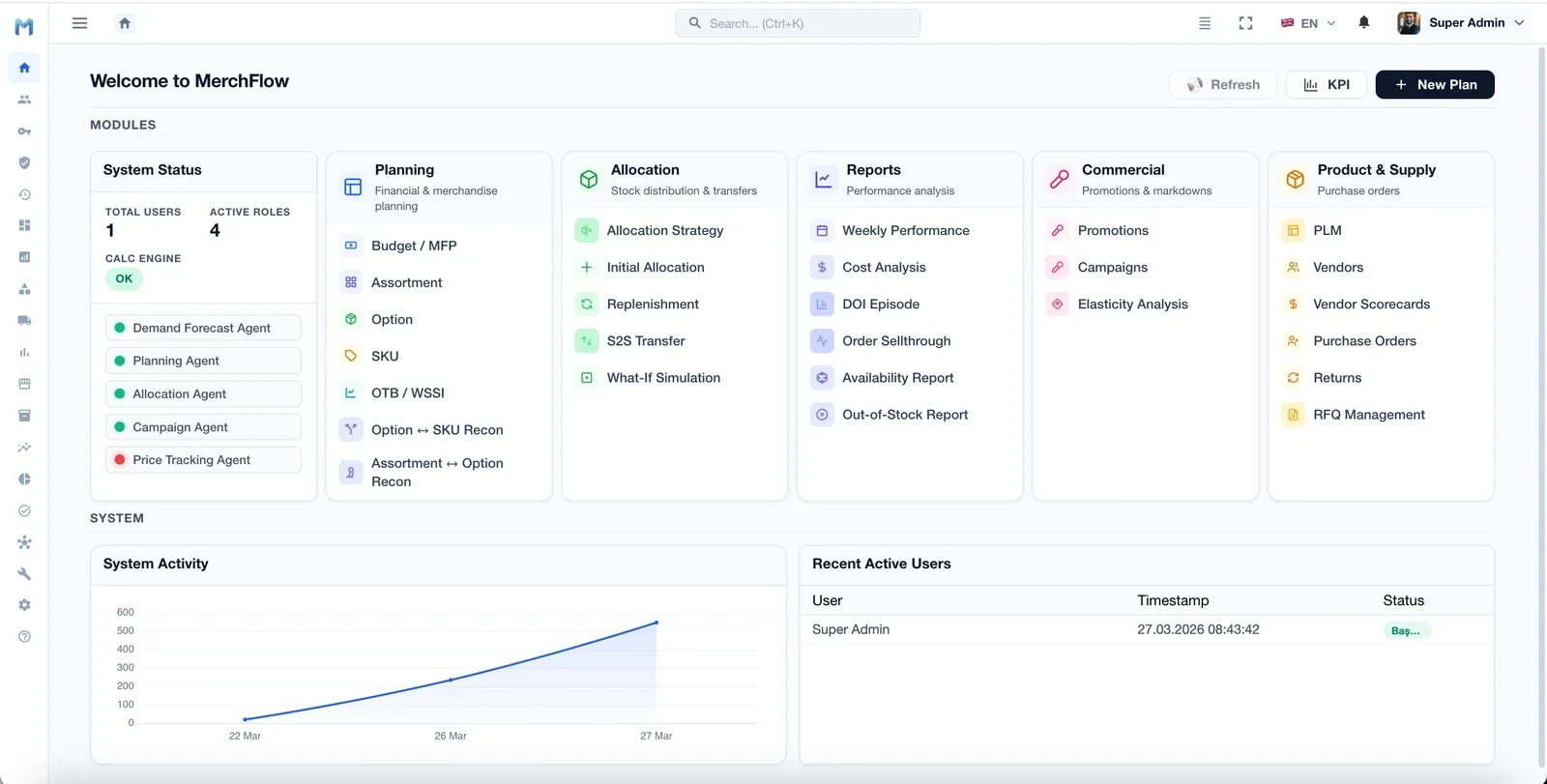
Related modules on screen
- Replenishment
- Forecast-driven replenishment proposals
- S2S Transfer
- Store-to-store transfer proposals
- Initial Allocation
- First distribution of new products to stores
Data this decision needs
- Sales history at SKU-store level
- Price and markdown history
- Promotion calendar
- Stock history (to spot stock-out days)
- Product attributes and hierarchy
- Store data
Frequently asked questions
What is demand forecasting?
Demand forecasting predicts how much of a product will sell at a given store or channel in a coming period. In retail it is usually done at SKU-store level by week or day, and it is the core input to replenishment, transfer, allocation and pricing decisions.
Is demand forecasting the same as sales forecasting?
No. A sale only happens while there is stock on the shelf; once a product sells out, sales read zero even though demand continues. Demand forecasting corrects for these lost sales to estimate true demand, while raw sales history understates it.
Why does stochastic optimization matter?
Stochastic optimization treats demand as a probability distribution rather than a single number. Target stock and replenishment decisions then carry a larger safety margin where demand is uncertain and a smaller one where it is stable.
What data does MerchFlow use for demand forecasting?
Discovery assesses the availability of sales history, product and store data, prices, current inventory and replenishment data. Pilot scope depends on the selected category, channel and data quality.
Let's plan a demo on your own data
The initial discovery call is free. Tell us your scenario and we'll propose a roadmap.
Request a Demo