Retail Allocation
Allocation decides how much of a newly arrived product goes to which store and, where it matters, in which sizes and colours.
MerchFlow automates allocation: products are distributed by each location’s sales potential.
Why allocation matters
The first distribution of the season strongly shapes how a product will sell. Send too little to a high-potential store and sales are lost; send too much to a low-potential one and the product ends up marked down or needs transferring later.
A new product has no sales history, so allocation relies on how similar products performed, each store’s sales potential and the size mix. Combining this by hand for hundreds of stores and thousands of products is heavy work at the busiest point of the season.
How allocation works
Grade the stores
Stores are classified by sales potential (store grading), and similar stores share the same distribution rule.
Anticipate demand
Demand for a new product with no sales history is estimated from how similar products performed.
Apply the rules
Rules such as minimum presentation quantity, store capacity and size mix are set in the allocation strategy.
Prepare the distribution
Warehouse stock is split across stores, and part of it can be held back for in-season replenishment.
Allocation in MerchFlow
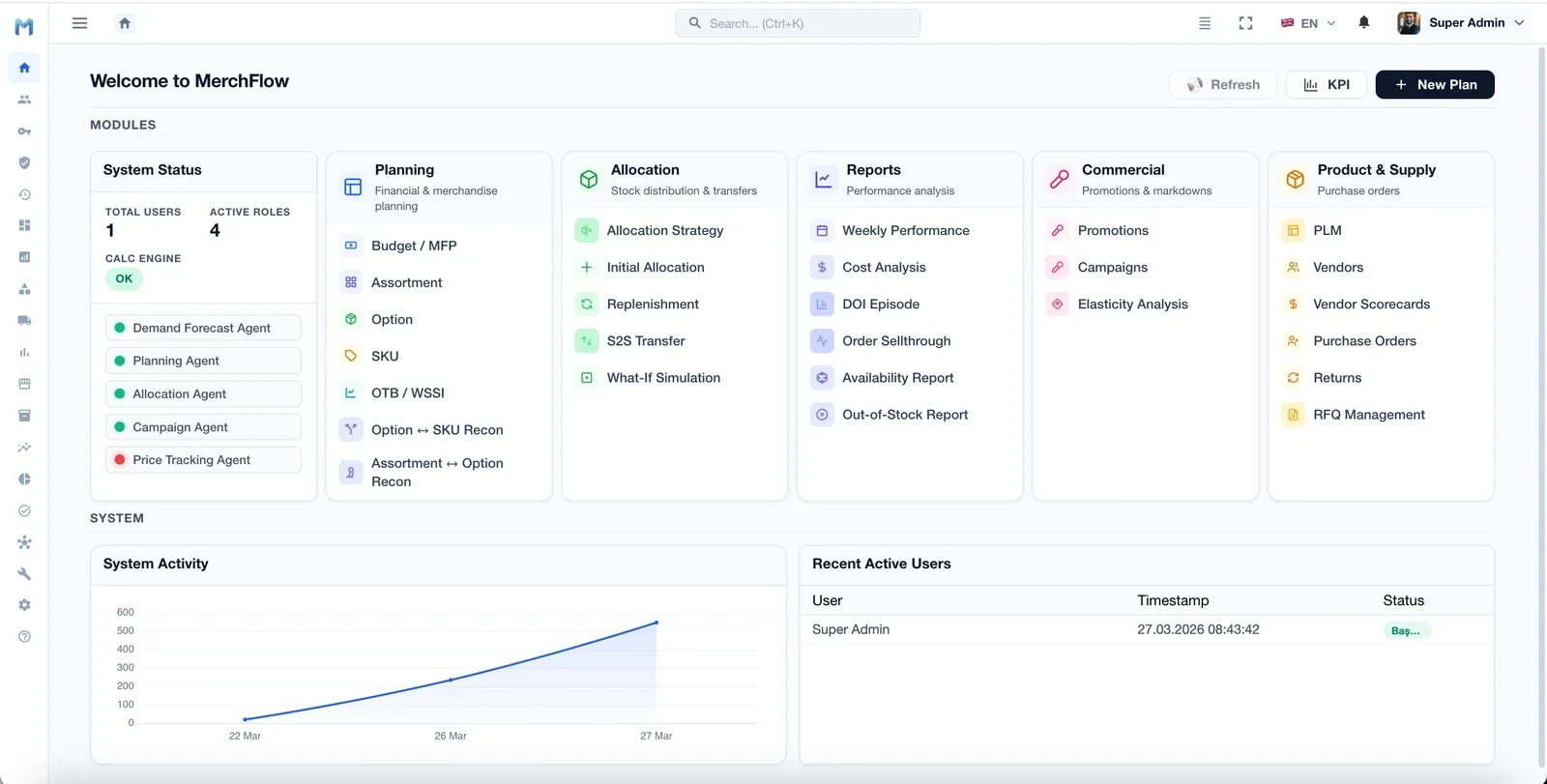
In MerchFlow, allocation is managed with the Allocation Strategy and Initial Allocation modules of the Allocation group, which also holds What-If Simulation. Store grading is among Genboost’s machine learning models.
Related modules on screen
- Allocation Strategy
- Defining the allocation strategy
- Initial Allocation
- First distribution of new products to stores
- What-If Simulation
- Seeing a scenario’s effect before acting on it
- Replenishment
- In-season replenishment
Data this decision needs
- Store data and capacities
- Sales history of similar products
- Size and colour mixes
- Distributable warehouse stock
- Minimum presentation rules
- Season and delivery calendar
Frequently asked questions
What is retail allocation?
Allocation decides how much of a newly arrived product goes to which store and, where it matters, in which sizes and colours. The first distribution of the season strongly shapes the product’s sales and how much transferring and markdown it will need later.
What is the difference between allocation and replenishment?
Allocation is the first distribution of a new product and is made without sales history, from similar products and store potential. Replenishment refills store stock to actual demand once selling has started. In MerchFlow they are separate modules: Initial Allocation and Replenishment.
What is store grading?
Store grading is the scientific classification of stores by sales potential. In allocation, stores of similar potential share the same distribution rule, so rules are managed by grade rather than store by store.
How does an allocation pilot start?
The initial discovery call is free. Discovery typically takes 2–4 weeks and the pilot (PoC) 4–8 weeks; pilot scope depends on the selected category, channel and data quality.

Let's plan a demo on your own data
The initial discovery call is free. Tell us your scenario and we'll propose a roadmap.
Request a Demo